
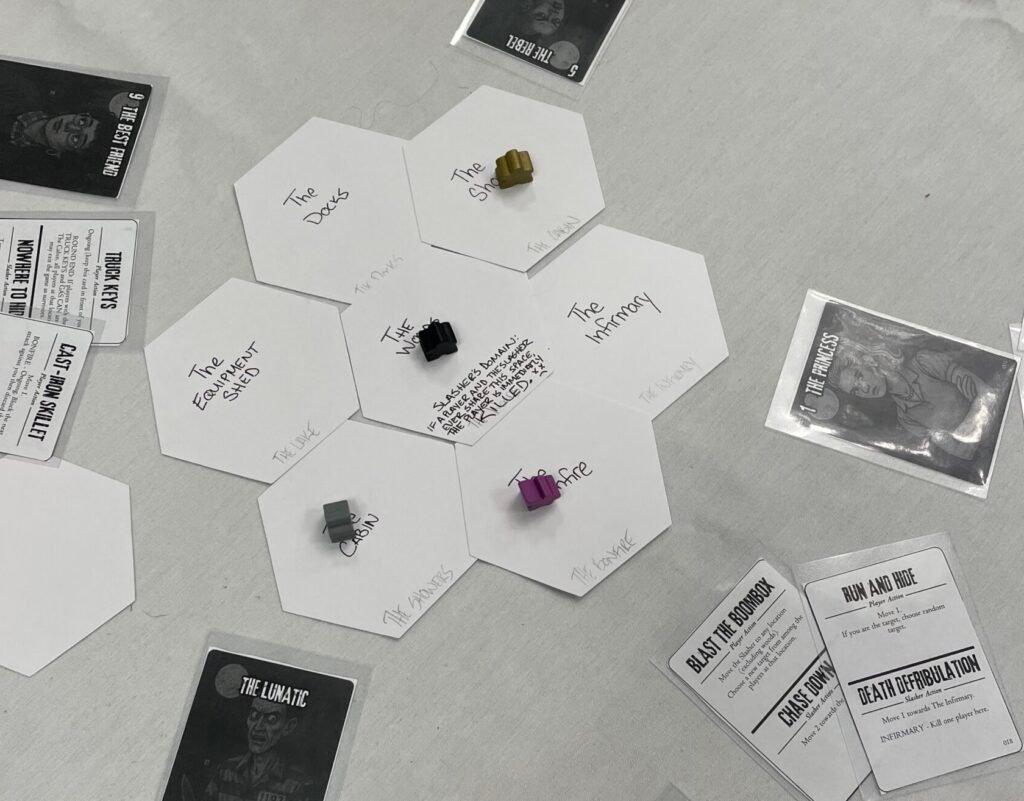
Last weekend I attended my first Protospiel ever, Protospiele Chicago 2025.
What a rush. I loved it.
At Protospiele, board game designers playtest and critique each other’s prototypes. Plus there are cookies. I had a great time meeting other designers, playing games, giving feedback, and getting some feedback on one of my current game designs, codename: Slasher.
Thematically, Slasher is set inside a 1980s summer camp slasher movie and the goal is to survive by fighting or fleeing. Mechanically, the design aims to be a fast-paced (<10min), semi-cooperative, elimination game. In this version, players draw and play thematic action cards (Lock the Door, Night Swim, etc . . .) to defend themselves and put the other players in peril.
Good news: the current version of the game is half-baked and borderline unplayable.
I’m being hyperbolic, but the game isn’t as far along as I’d thought. Regardless, the feedback was helpful.
The biggest recurring issue was that players said they didn’t have a clear sense of what they were trying to do, which confused me. Their goal was simple (try to be the last player alive), and the gameplay was simple (draw two cards, play the top of one and the bottom of the other).
But after asking some pointed questions, I realized that the actual issue wasn’t that players didn’t know what they were trying to do, they just didn’t have a sense of how they could accomplish it. They understood “Play cards. Don’t get eliminated,” but they didn’t understand how specific cards could meaningfully advance their goals.
Players lacked the ability to strategize and pursue a clear path to victory.
This was an intentional part of the design executed poorly. The cards and gameplay in this iteration were supposed to be simple, thematic, swingy, and chaotic, leading to sudden player eliminations. Gameplay was supposed to feel like a jump scare kill scene. But if every card leads to (or prevents) sudden death, it’s hard to strategize for a long-term victory.
But why?
The first version of Slasher resembled a horror version of Forbidden Island, with players moving around a modular location board, accumulating resources and hoping to survive. Unfortunately, the market doesn’t need another 60-90 minute Summer Camp Slasher game. Final Girl is a beloved solo game and Camp Grizzly Second Edition just raised nearly $500k on Kickstarter.
But I love the theme. So my goal became developing a small, fast-paced game that delivers a Summer Camp Slasher experience in 10 minutes or less. Inspired by games like “We Didn’t Playtest This,” “Exploding Kittens,” and “Fluxx,” I wanted to incorporate a high degree of chaos. However, I also included very strategic elements like board movement/position and player initiative. In the end, the design was trying to do too many conflicting things (I think).
The plan for the next iteration:
- Remove the board. A lot of fast-paced, elimination games I like are cards only.
- Make certain win conditions more obvious by including “goals” or “plans” or something.
- Remove most of the horror flavor from the mechanics for now, see if the gameplay systems can be optimized.
There was also feedback that misunderstood the intent of the design. i.e. suggestions that would lengthen play or add complexity. This feedback will be ignored.